
Mariko Nagai
Excerpt from Afterlives
(a speculative memoir)
It is always windy on the first night of the obon. (I used to believe that) breeze was a ghost passing by. Gales of the obon must have been the rush hour of the dead, all clamoring to come home. (My mother swore) she swore that when my father raised the axe to behead the injured cock, it croaked Ta-su-ke-te-ta-su-ke-te (which can be translated as Help me, help me, or Have mercy, have mercy, or Don’t kill me, don’t kill me). My father was raised on the farm (he used to tell me about how when he was a boy, he helped his father neuter pigs by holding the testicles at their root and slicing open the sacks with a used razor. He had practical cruelty about him: When one of our cats gave birth to deformed kittens, he took them to the bridge and threw them, one by one, and when they floated up, he threw rocks at them. He told these stories with a gleam in his eyes. So that day, when he missed his aim and cracked open the cock’s head, he raised the axe that was, only minutes ago, chopping up branches, to behead the cock. And it croaked Ta-su-ke-te-ta-su-ke-te (my mother swore that’s what she heard) and my father laughed with that gleam in his eyes (my mother swore) and she stopped him, “If it’s meant to die, it’ll die, just let it be,” and my father said, “And you want it to suffer?” but she heard what she heard, she heard the cock croaking Help me, have mercy, and my mother said, “Look, it’s begging for its life, just let it be.” It lived on for some more years. Don’t photograph a sleeping person. That’s what they look like when they die. More than anything in life, I wanted a cat (or a dog) when I was small. (One cock, and hens we had plenty because we lived on a farm at the very edge of Tokyo, but those were farm animals, their use as good as they served my father’s mother’s practical needs.) I used to buy dog magazines (now that I think about it, Aiken no Tomo was a magazine for serious breeders) and begged and begged for a dog - or a cat. After some time, my grandmother finally said yes, but to a cat (because they would catch rats), but not a girl. Girls get pregnant (and it’s too much to give them away whenever they got pregnant, and they got pregnant twice a year.) So we went to a Tokyo Hands (now a fancy DIY and stationery chain) in our neighborhood. There were kittens on sale for 500 yen. We picked a black boy cat, but a year later, our family moved to the US and the black cat stayed with my grandmother, getting fatter and bigger, feeding on her resentment and anger. The cat and my grandmother were close - the black cat roamed the neighborhood and impregnated the neighborhood cats at night and kept her company during the day. She used to write letters to us, ordering my father to quit work and come back to Japan, saying that the cat was more loyal than us. Kuro (yes, his name was “Black”) lived more than five or six years until my grandmother, in her mid 80s, was found unconscious at home, and no one found her for an entire day because she lived by herself (my uncles would visit every other day and ate dinners that she cooked for them). Kuro went missing while she recovered in the hospital. My grandmother came home and lived on for one more year. Kuro never came home. My uncle wrote to me, “Kuro gave one year out of his life to your grandmother; he sacrificed himself so that she could live.” Japanese word for widow is 未亡人, a word used exclusively for women. It means one who hasn’t died yet, as if she is not with the living, but not with the dead either, though that’s where she belongs. My grandmother’s farm was at the bottom of the curvy road that encircled a cliff. It was woody and unwelcoming. The name does not show up on maps, but we called it Hospital Hill. There used to be an imperial military hospital for severely wounded soldiers (someone told me); it was a military hospital for soldiers who lost their minds during battles and they used to wander around still thinking that they were fighting (I don’t remember who but I remember someone telling me); it was a hospital during the war and that’s where all the injured from air raids went to and that’s why (my brother told me in his overconfident way of speaking and he would always lower his voice and avert his eyes) that area has such dark feeling; even the local history book is vague - there was (maybe) a sanitarium for tuberculosis patients about 150 years ago; another book says, it wasn’t a sanitarium, really, it was more like a hut for one or two sick people. An elderly man (interviewed in a book published fifty years ago) remembers ghost-like men and women, their faces covered in rags, gathering mushrooms along the forest at night. Even in the 1970s, no one liked going up that hill: Always dark, even during the hottest summer days, the hill was so steep we ran out of breath if we walked too fast. Atop the hill, there was a one-story wooden building with a sweetshop, a produce shop, and (if I remember correctly) a simple restaurant, and when you stepped into that building, it felt as if you stepped into another era, where
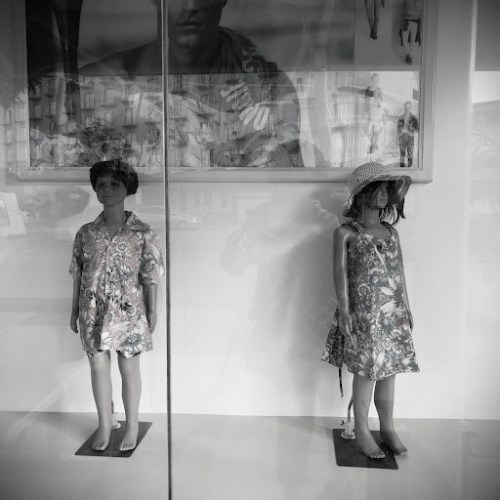
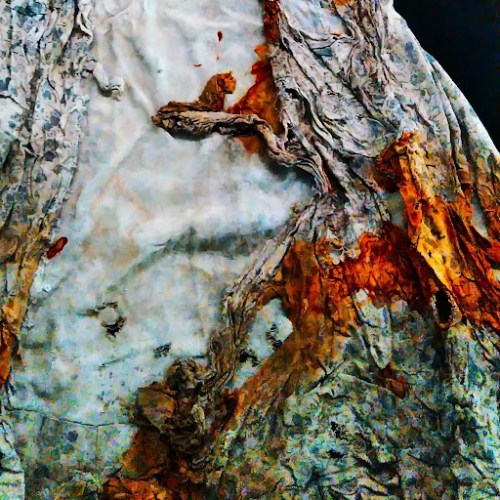
A Boy and a Girl & What She Was Wearing
nothing had changed for a hundred years. An umbilical cord attached to a newborn will fall off: keep it and put it in a box of paulownia tree. If a child is gravely sick, feed it to them - it will save their life. And if and when that child dies, put it in the coffin. It will lead the former child/now an elderly person back to his dead mother. I used to play in a grove at the bottom of Hospital Hill. During summer break, we (who are these we? Were they my friends, or were they other kids, and like kid friendship, we formed a loose confederacy?) would walk barefoot in the stream where we would catch crawfish (we didn’t eat them, we kept them as pets) but we never got close to the tunnel dug against the hill. (I remember someone telling me that) It used to be a bomb shelter during the war period. (Someone said that) The bomb shelter used to have a steel door, and on one evening near the end of the war, people evacuated into the shelter when the air raid siren went off, and they baked to death from the incendiary bombs that lit up the grove. The darkness of the tunnel seemed so vast, the blackest of the dark, and even within a few steps, the coolness turned into frigid air, and it felt as if we were walking into the otherworld. We believed that it connected us to another time, a long, long time ago, before my time. During Obon - Three Days of the Dead - the wall between this world and the otherworld collapses. The dead are around us. For three days, they haunt the living. For three days, the past tense and the present tense become the same. They snake into the dreams of the living; they sit around the dinner table; they eat without eating. And on the third night, they leave, and the living go back to living in the possibilities of the future, continuous. On my way to and from elementary school, I held my breath whenever I had to walk by this particular property - a property that seemed to lean against the concrete cliff like a tired man. Atop the cliff were houses and houses, all big, all fitting for the neighborhood it was part of, but this property seemed to have spurned the grandeur of its surroundings: a dry-blood colored house, leaning against the concrete cliff surrounded by a grove, and an antique well, the kind with a steel handle that you needed to pump. The house seemed abandoned, though once in a while, I saw clothing drying on the laundry line. (I remember a classmate telling me) Though there was no pond, the property was called Head Washing Pond. My brother
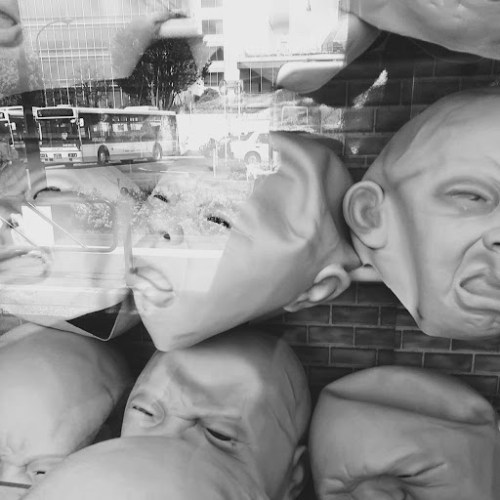
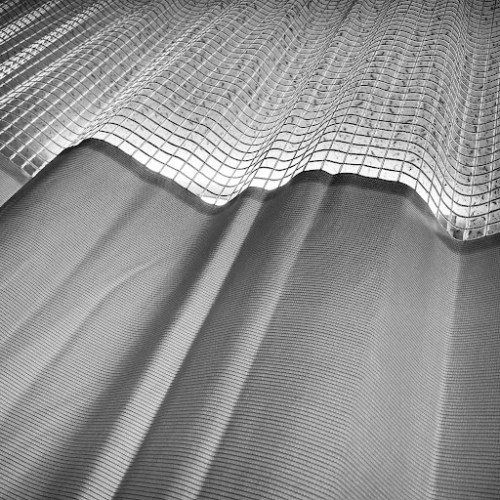
Masks & Hospital Curtain
(in his conspiratorial way) said in a hushed voice that that’s where all the executions took place a long time ago during the Edo period (though historically and factually, that was impossible). (I still remember) a lonely white undershirt hanging from the clothesline, billowing, headless and legless, surrendering to the wind. When there is an earthquake, run to the bamboo grove. Bamboo roots interlock deep in the earth. Hold on to bamboo. You will be safe. I had many secrets: I wished my parents would divorce so that my grandmother would stop being so harsh toward my mother, so that we didn’t have to be scared of what my father’s next mood would be because it changed like the pupils of cats; I wished that one of these days, my elementary school would be flooded so that some kids would have to transfer to other schools; I hated how my grandmother smelled - I knew she washed (she walked around naked twice a day and that’s how I remember what her breasts looked like, two pendulums that hung down to her navel) but she always smelled of something bitter, my tongue curling whenever she leaned close to me, her denture floating in the vast darkness of her mouth; I hated summer when we slept under the green mosquito net, our world protected by smoke from mosquito coils, and when I looked up, I could see eyes of my ancestors, eyes looking down, my grandmother standing outside of the net, already a ghost surrounding the green fragile veil that separated the living from the dead; I hated when people asked me, “Do you remember when…” and I didn’t know what to say (I didn’t speak until three, after we moved to Belgium; my mother took me to the doctor when I was two, and the doctor told her, “Don’t worry, she understands everything, she’s just waiting to be able to speak when it’s her time,” and I don’t remember, but my mother says that the first time I spoke was in a complete sentence in Flemish, though I don’t know how she knew it was a complete sentence because she never learned Flemish.) A long, long time ago, before my time, people believed that twins were bad luck; they were a sign of the “dog womb.” One half of the pair would be taken away (sometimes killed) so that there was no confusion of who was whom; there was no confusion of one soul split in two bodies. When we moved to America, ghosts must have stayed in Japan. We didn’t celebrate Obon anymore. We didn’t have an altar for our ancestors anymore. American ghosts seem alien to us, as much as we must have been strangers to them.

Born in Tokyo and raised in Europe and the U.S., Mariko Nagai received an MA in Creative Writing – Poetry at New York University. Her numerous honors include the Erich Maria Remarque Fellowship from NYU, fellowships from the Rockefeller Foundation Bellagio Center, UNESCO-Ashberg Bursaries for the Arts, Yaddo, and Djerassi, Akademie Schloss Solitude, amongst others. She has received the prestigious Pushcart Prizes both in poetry and fiction. Her books include Histories of Bodies: Poems (Red Hen Press), Georgic: Stories (BkMk Press), Dust of Eden: a Novel (Albert Whitman), Irradiated Cities (Les Figues/punctum), Under the Broken Sky: a Novel (Christy Ottaviano/MacMillan), Body of Empire (Tarpaulin Sky Press), and Imaginary Death (punctum press). She is Professor of Creative Writing and Japanese literature at Temple University Japan Campus in Tokyo.
A Song for Mariko

