
Robert Gillespie
Shattered Soul I
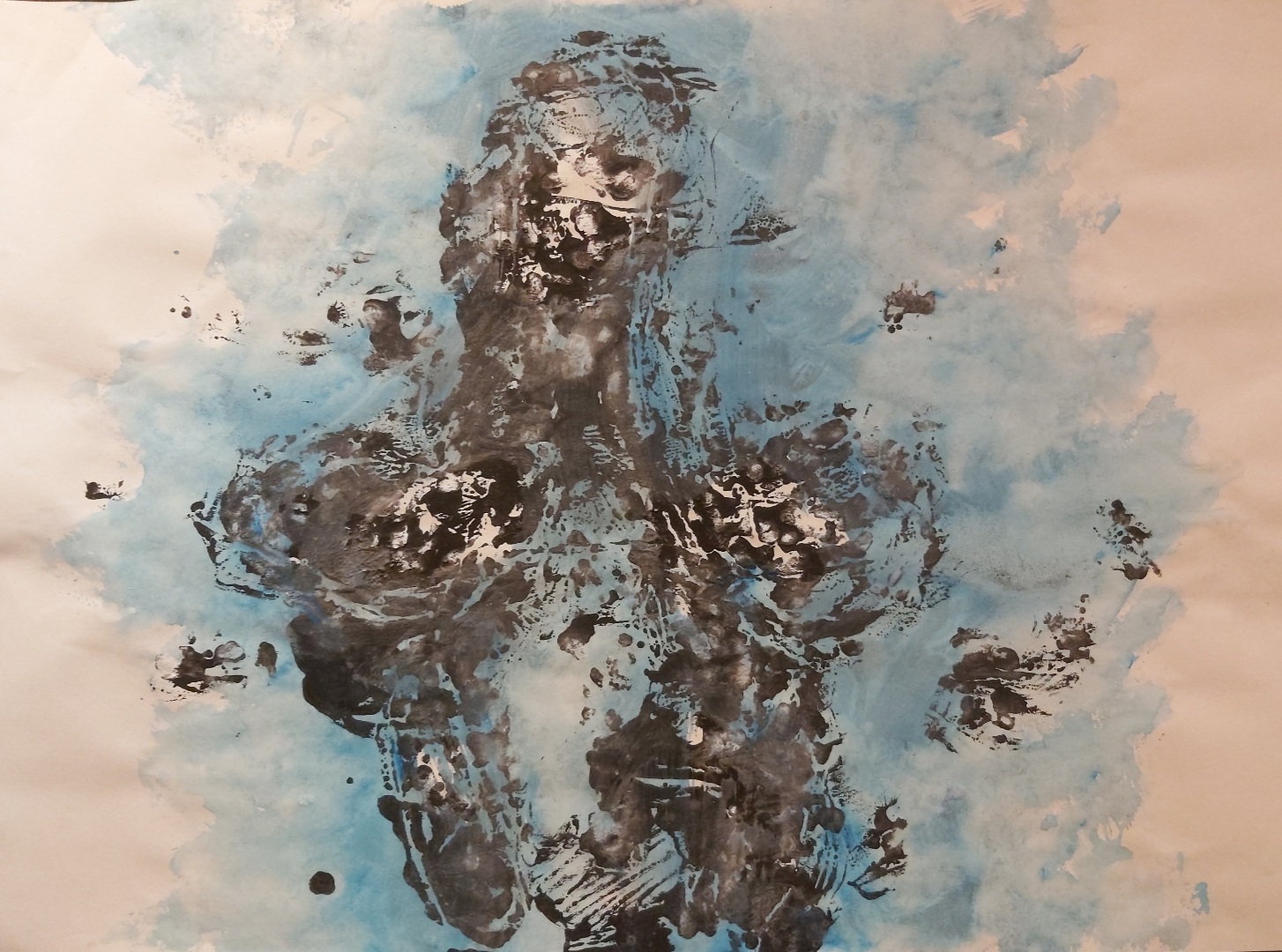
Acrylic monoprint on paper, finished with touches of color. 59cm x 42cm
Born in 1966, Robert Gillespie was small, skinny, geeky, and looking more like a girl than a boy, his sexuality was always questioned. In Derry during ‘the Troubles,’ that was nigh on life threatening. He stood out in all the wrong ways. It was an impoverished, brutalized and traumatized society, and he was brutalized and traumatized by that society. He was afraid. All the time. Gillespie was, in many ways, a pariah and that caused him to develop a very ambivalent, distorted view of humanity and his surroundings.
But he could draw.
Gillespie’s background and experiences of coming from Northern Ireland permeate all his work. Not always in ways that are initially obvious.
Gillespie has released two albums of experimental electronic music, exhibited photography and 3D works at the Social Gallery, Derry. He had a video installation as part of the ISSTA sound art conference at Magee University, Derry. He was also winner of the Ambit Magazine Art Prize (Magik)Ambit 249.
Now living in London, He is currently working on multiple sound art and conceptual photography series’, which should be published and exhibited over the coming year.
Artist Statement: Cognitive Dissonance is the psychological distress caused by a person’s beliefs conflicting with new information perceived. In response, the person tries to find a way to resolve the contradiction and so reduce their unease. Through my work, I want to make people examine their belief systems, and through their cognitive dissonance, bring about paradigm shifts. By using the recurring motifs of machines, masks and monsters, I make the viewer confront the awe, the fear and the wonder that is the Sublime.
I work predominantly in multiple thematic series’ that frequently incorporate fictive characters and narrative components. As a multidisciplinary artist, some of these series are lens based; others can be painting, costume, sculpture, mixed media and sound art.
My mixed media works are fabricated from found objects and recycled materials.
My work contains a strong autoethnographic aspect resulting from my experiences of coming from a society mired in sectarian conflict. I was not immune to the effect of this, and it emerges in my work, sometimes only revealing its presence over time. I regularly use found objects and reused or recycled materials because my family did not have much money when I was growing up, and art is an expensive activity.
My earliest influences were John M Burns, Neal Adams, Derek Meddings and Joe Johnson. My aesthetic was later informed by the works of Victor Burgin, Mike Kelley, Joseph Kosuth, Jenny Holzer, Louise Bourgeois and Laurie Anderson.

A Song for Robert

 Club Plum